The First Official Baca County Fair

In September 1914, Springfield did not have a fairgrounds. There were no permanent exhibit halls, no livestock barns, no grandstand, and no long-established fair board with years of experience behind it. What Baca County had instead was a town willing to become a fairground, a newspaper willing to champion the cause, and a county full of people determined to prove what their farms, ranches, schools, homes, and communities could produce.
Let's start by painting a backdrop. The year was 1914, and in the Southeast Corner of Colorado, a young frontier county called Baca was beginning to establish itself as a cornerstone of rural life in the west. The county had only been organized 25 years earlier in 1889, but had already grown from a smattering of farmers and ranchers looking to stake their claim to a homestead community of about 2,500 residents (1910 U.S. Census). Several small towns had already been established in the short existence of Baca County - frontier villages grew into rural metropolises like Minneapolis and Wild West Boomtowns like Boston - and by the early 1900s, several towns that would persevere into the present were already alive and well (Springfield, Pritchett, Walsh, Campo, Two Buttes, and Vilas).

Agriculture was the backbone of the county’s economy. Farmers practiced dryland farming, growing crops such as wheat, corn, and sorghum in a region where rainfall was limited and unpredictable. Ranching was equally important, with cattle and horses raised on the open plains. Life in rural Baca County required resilience and cooperation. With farms spread far apart, community events were especially important during this period of our history. Gatherings such as church socials, school events, and fairs brought residents together and helped build a sense of identity for the young county. As Baca County grew, so did the need for these opportunities for community.
During the early 1900s, across the Great Plains, county fairs were becoming popular as a way for farmers and ranchers to display their best livestock, crops, baked goods, and crafts while celebrating the agricultural year.
It was in this environment—of hardworking farmers, small prairie towns, and a growing sense of community—that local leaders in 1914 began organizing Baca County’s first formally planned county fair.
Early Calls for a County Fair
The idea of holding a county fair in Baca County began circulating before 1914 - in fact, there were discussions of an event almost as early as the County's creation in 1889. This year wouldn't even be the first fair held in the county; there had been earlier festivals and fairs in towns like Boston and Minneapolis and Two Buttes; even Stonington had successfully hosted a "farmers fair" years before. But an official, coordinated, large-scale "Baca County Fair" had continued to elude the settlers despite rumblings that one should be created. As such, the story of the first real Baca County Fair starts early in1914. Fortunately for those of us who are connoisseurs of local history, the proposal, process, and outcome of this fair was well documented through letters published in the Springfield Herald.
Above: Letter from Jas. N. Miller advocating for the creation of a Baca County Fair. From the Springfield Herald (Springfield, Baca County, Colorado), Vol. 27, No. 26, February 6, 1914.
Above: Letter from B.H. Jones advocating for the creation of a Baca County Fair. From the Springfield Herald (Springfield, Baca County, Colorado), Vol. 27, No. 32, March 20, 1914.
One of the earliest and most enthusiastic voices was Jas. N. Miller, a farmer living near Rodley. Writing to the newspaper, Miller encouraged residents to organize an agricultural society and hold a county fair to promote farming in the region. He believed the fair would serve several purposes. It would allow farmers to compare crops and livestock, encourage better farming methods, and help advertise the productivity of Baca County. He emphasized that a county fair would be no small feat - "it would require hard work, and perhaps personal sacrifice on the part of promoters" - but argued that the benefits would be well worth the effort.
Other residents soon joined the conversation. Writers from communities across the county—including Stonington, Vilas, and Springfield—sent letters expressing their support and offering ideas for how the fair might work. B.H. Jones from Stonington quoted former President William McKinley, who had once described fairs as the “timekeepers of progress.” He enthusiastically promoted the idea of the fair, saying:
"We have the people, we have the stock, we can produce the crops! So roll up your pumpkins, boys, and polish that cow's horns. Blanket old Bill, and get ready for the biggest time of your lives at Springfield next fall."
Letters continued to pour into the Herald over the next few months, each emphasizing different advantages to hosting a County Fair and making suggestions for how a fair could be achieved. Many, like Miller, argued the practical and educational advantages of displaying agricultural and industrial achievements of the region: a fair would show what Baca communities were capable of producing! Others, like Robert J. Homsher, argued for the social appeals: "A fair gives a chance to meet with the old and new friends and would give a few days' recreation from the long summer's toil." Support even came from parts of Kansas and counties to the north: N.N. McLean wrote into the Herald from Lamar with the simple statement that if we held a County fair, he "shall certainly attend." Ultimately, feeling the conversation had run it's course, the calls turned to a general sentiment of "Let's get to work and get this thing done!"
Above: Various letters of support for the Baca County Fair, all published in the Springfield Herald in April and May of 1914. Letters came from Robert J. Homsher from Springfield, Colorado (April 10th, 1914), Lucius McAdams in Vilas, Colorado (April 17th, 1914), N.N. McLean from Lamar, Colorado (April 17th, 1914), L.M. Jones from Rodley, Colorado (April 24th, 1914), the Sentinel (another newspaper; support published in Herald on April 24th, 1914), W.H. Denney from Springfield, Colorado (May 8th, 1914), and District Attorney L.H. Alberti (May 22nd, 1914).
Wherever they hailed from and whatever their personal take on a County Fair, one thing was clear by the end of May 1914: the writers all agreed that Baca County had everything needed for a successful fair. We had productive farms, hardworking residents, a growing agricultural economy, and a need for a little local entertainment. All that was needed was someone to organize it.
Turning an Idea into a Plan
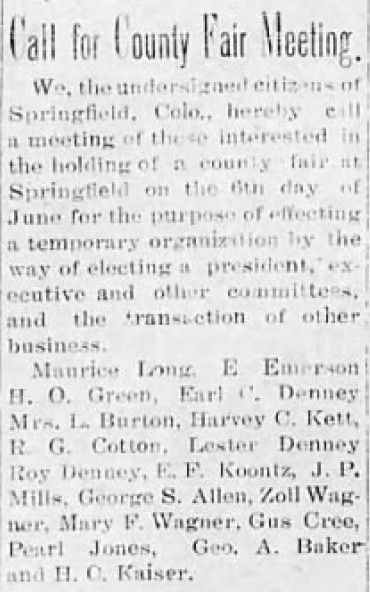
Once the vast support for a Baca County Fair became evident, a group of community leaders took to the task of getting organized. On May 22nd, 1914, local citizens issued a formal call for a public meeting that was to occur on June 6th in the town of Springfield. In the next issue of the Springfield Herald, the citizens made the same call again, this time pushing up the timeline and advertising the meeting for June 3rd. The purpose of the meeting would be to organize the original version of the Baca County Fair Board, electing officers and creating committees. This original committee included several prominent community members such as W. F. Wagner, Byron Scarborough, George Baker, A. A. Denney, Maurice Long, and Ed Emerson. They called it the Executive Committee of the Baca County Fair Association, and the project was off and running.
Their task was simple in theory, but difficult in practice: create a county fair from scratch. The challenge of the task was eloquently outlined in great detail before the first meeting ever occurred, presumably by Springfield Herald editor S.M. Konkel, in an extended article published on May 29th, 1914. In this letter to the community, Konkel described what kind of organization and management would be required to make the County Fair "the kind that Baca County wants and can have." He emphasized the following points:
Financing the Fair. The author surmised the entire affair would cost between $250-300 (roughly equivalent to $8,000 - $9,500 in 2026). Konkel discussed aspects of a County Fair that required financing, and mused about where the budget could be cut to minimize the cost, but the ultimate question was how the committee would come up with the money, whatever the final sum might be?

Exhibits and Displays. A major purpose of the fair would be to showcase the productivity of Baca County. Farmers and residents were encouraged to display crops, livestock, and other products produced through their work.
Since there were no permanent fairgrounds yet, where would everything go? He suggested that buildings such as the local schoolhouse, business storefronts, and other available structures could be used to display exhibits. For livestock, simple pens made from barbed wire fencing would likely be constructed.
Attractions & Entertainment. Finally, what would a fair be without attractions? This point was made clear, though few actual suggestions were made, leaving the ever-important question to the committee. However, this early article set expectations high: big attractions of the time - like a "flying machine" - seemed feasible to the author.
The article carries on at some length, discussing logistics and considerations that would ultimately fall to this first Fair committee, but one thing was clear: Baca County would have to band together to pull off their first County Fair.
Above: Letter from Editor Sam Konkel outlining all the logistics of hosting a Baca County Fair. From the Springfield Herald (Springfield, Baca County, Colorado), Vol. 27, No. 42, May 29, 1914.
A Fair Without Fairgrounds
Perhaps the single most remarkable thing about the first Baca County Fair wasn't what it did have, but rather what it did not have...and what we did not have was a permanent fairgrounds. It would be over 40 years before the Homsher family would donate the land that the Baca County Fairgrounds sits on today; in 1914, however, a permanent location for a county fair was a pipe dream. Baca County didn't have a race track. It did not have fenced grounds, fair buildings for exhibits, livestock barns, ticket booths, or grandstands. This was acknowledged in the Springfield Herald as a potential barrier and, in the same breath, dismissed by the proponents of the fair as a reason to not hold the event. Baca County didn't need a fancy setup to hold the first fair: this first attempt would be practical, temporary, and a little bit improvised. The proposed solution? The town of Springfield itself would be the fairgrounds,
The exhibits would go in the schoolhouse. Displays of crops, produce, and domestic goods would be put up in storefronts and business buildings around the town. Even the "telephone building" was recruited as a site for fair activities. Livestock would be managed in arrangements of temporary pens - ranchers of the day could construct barbed-wire enclosures in no time at all! The parade would travel down the streets of town, and a race track...well, that just required an open field and some rope to mark the course.
Advocates and organizers of the first county fair leaned into this "lack" of facilities and, perhaps unintentionally, elevated the charm and appeal of the event. By involving the entire community in hosting the fair, the first Baca County Fair wasn't just a fair hosted in the town of Springfield. For three days in September of 1914, the town of Springfield was the Baca County Fair.
Raising Money and Building Support

One of the first challenges was funding the fair. Organizers estimated that about $250 to $300 would be needed to cover expenses such as prizes and advertising, which was no small sum - that's over $8,000 in today's money. But the general feeling was that there shouldn't be any charge for admission to the first fair either. Ultimately, the committee decided that they should raise money through donations. The response from the community was immediate.
Within a single day in Springfield, more than $150 was raised. One of the most important supporters was Mrs. Bailey, who donated $50 herself and helped collect more than $100 in additional contributions in just a few hours.
Community fundraising events were also put on to support the fair. One of the most memorable was a Fair Pie Social held at the Springfield schoolhouse in July. Dozens of pies baked by local women were auctioned to the crowd, raising more than $61 for the fair fund. The evening also included music and entertainment, and the event helped build excitement throughout the community.

Above: Advertisement for the Pie Social printed in multiple editions of the Herald
Left: Recap of the Pie Social to raise money for the first Baca County Fair. From the Springfield Herald July 10th, 1914.
Planning the Attractions

As summer progressed, the organizers began planning the attractions that would make the fair memorable. Agricultural exhibits would form the heart of the event. Instructions published by the Executive Committee said that "at least one sheaf of each kind of grain as well as a liberal sample of threshed grain should be saved and prepared for exhibition" and advised that the condition of the sample as well as their "neatness" would be considered in judging. Farmers were encouraged to save their best samples of other produce as well, including melons, vegetables, and so on. Livestock displays would feature horses, cattle, and poultry raised by local ranchers.
The fair would also include a wide variety of entertainment. Plans were made for bucking contests, ball games, speeches, and social gatherings. Central to the idea of the first Baca County Fair was racing...racing of every size and color! Organizers planned races for automobiles, motorcycles, and bicycles—modern attractions that reflected the changing times. These races would be accompanied by horse races, mule races, and even foot races. The fair would be alive with music, much of which was provided by the Lamar Brass Band who performed throughout the fair. The Herald even speculated that a "flying machine" might not be impossible, a reminder of the excitement surrounding modern technology in the years just before World War I. All of this together created a Baca County Fair tradition that still holds firm today: we celebrate the "old" ways with horses and broncs and agricultural traditions, and we marvel at the new technologies and features of the world as they unfold.
The Grand Parade

One of the most ambitious ideas for the first county fair was a grand parade through Springfield. Organizers encouraged every neighborhood in Baca County to build decorated floats representing the industries and products of the region. A $25 prize was offered for the best float. Some suggested float ideas included:
a country school scene with students and a teacher
displays of crops and agricultural products
humorous exhibits showing “how not to farm”
floats representing livestock industries such as sheep or cattle
The parade was intended to showcase the creativity and pride of Baca County residents. If enough communities participated, organizers believed the procession could stretch for miles. The parade was intended to be a moving catalog of the county's life and labor; it was not only meant to show what Baca County could produce, but to show who Baca County was.
Above: Article entitled "About the Floats" from the Springfield Herald August 7, 1914.
Special Events and Visitors

Organizers also planned special events that would make the fair more than a display of crops and livestock. One of the most meaningful was Old Soldiers’ and Old Settlers’ Day, planned as a reunion for veterans, early residents, and their families. The notice published in the Springfield Herald invited “all old soldiers and their families, all old settlers and their families, all younger settlers—and all ex-confederate soldiers” to attend on Thursday evening, the second day of the fair. The Old Soldiers’ Committee hoped the gathering would become “one of the days of the fair to be remembered in the history of the county,” with addresses, music, and old songs included as part of the program.
The reunion was important because it connected the young county fair to the older story of Baca County itself. The fair was designed to celebrate the county’s future—its crops, livestock, schools, homes, and growing towns—but Old Soldiers’ and Old Settlers’ Day gave space to honor the people who had helped establish those communities in the first place. In a county only twenty-five years removed from its organization, the gathering served as both a reunion and a reminder that Baca County’s progress had been built by settlers, veterans, families, and neighbors who had endured the hardships of frontier life.
Above: Article about Governor Ammon's attendance from the Springfield Herald April 10th, 1914; Keating article from April 17th, 1914.
Prominent visitors were expected as well. From the beginning, the Herald predicted that the first fair would draw people from across the county and surrounding region. The May 29 planning article anticipated that “practically all of Baca county” would attend at some point during the three days, along with visitors from Lamar, Holly, Syracuse, Morton County, and the new town of Elkhart. The article also suggested that Governor Elias Ammons, Congressman Edward Keating, and other state and national figures would be invited.
These plans show that organizers were thinking beyond a simple local exhibition. They wanted the fair to serve as a county-wide homecoming, a regional advertisement, and a public celebration of Baca County’s place in southeastern Colorado. By combining agricultural exhibits with reunions, music, speeches, visitors, and entertainment, the first Baca County Fair became something larger than a farm show. It became a gathering place for the county’s past, present, and future.
Finally, a Baca County Fair
On September 11th, 1914, the Springfield Herald published the official program of the Baca County Fair. While we can be fairly certain it doesn't encompass all the small details of what went on during the fair the year, it does remain one of the best surviving guides to what visitors could have expected to see during the first official Baca County Fair: sports, politics, music, food, reunions, and entertainment all smattered among agricultural exhibits and celebration.

The first official Baca County Fair opened in Springfield on September 16, 1914, and continued through September 18. By the time opening day arrived, the fair had been discussed in the newspaper for more than seven months. It had been promoted in letters, debated in editorials, organized through public meetings, funded through donations and socials, and built with whatever space Springfield could offer.
The first day appears to have been the beginning of the gathering rather than its peak. Races and games drew attention, but much of the fair's meaning was in the arrival itself: farmers bringing exhibits, families finding their places, livestock being settled, visitors reaching town, and Springfield adjusting to the presence of a county-wide crowd. The second day carried the formal weight of the event, with the parade, Governor Ammons' address, the baby show, races, and the Old Soldiers' and Old Settlers' reunion. The third day continued the celebration with another parade, speaking, races, and a final round of entertainment.
The Herald later estimated that around 2,500 people attended. For a county whose 1910 population had only slightly exceeded that number, the attendance was remarkable. It meant that the fair reached beyond Springfield, beyond one neighborhood, and likely beyond the county line. It had become what its promoters intended: a public demonstration that Baca County could gather on a large scale and show what it had become.
The Exhibits
The agricultural exhibits seem to have made the deepest impression. The September 25 coverage (below) called the fair a tremendous success and described the agricultural exhibits as an inspiration. The October reflection by Jas. N. Miller went even further. Having written one of the first articles urging a fair, it is appropriate that Miller also wrote the most excellent summation of the fair after attending. Milled raved that the garden, and orchard products were a 'revelation.' If such products could be shown throughout Kansas, he believed, they would send a stream of people to occupy Baca County's vacant lands.
Above: Letter recapping the first County Fair from Jas. N. Miller as published in the Springfield Herald on October 16th, 1914.
Miller's statement captures one of the fair's central purposes. The exhibits were not merely judged for ribbons. They were evidence. They showed that crops could grow, orchards could bear, gardens could produce, and families could make a living on land that outsiders still underestimated. The fair turned private labor into public proof.
The domestic departments also deserve attention. Miller specifically praised the 'needle and art work of the ladies,' and the prize list confirms the breadth of those entries. Items included bread made by girls under sixteen, canned fruits, pickles, preserves, quilts, crocheting, tatting, centerpieces, pin cushions, school exhibits, flowers, watercolor, oil paintings, pastels, and burnt work. The fair was not only a story of agriculture in the field. It was also a story of kitchens, sewing rooms, classrooms, gardens, and homes.
Above: Recap of the first County Fair as published in the Springfield Herald on September 25th, 1914.
Races, Games, and the Energy

If the exhibits were the heart of the fair, the races and games gave it energy. The Herald's race coverage listed
mule races, buggy races, bucking contests, relay races, running races, and foot races. Some names in the surviving clipping are difficult to read, but the list itself shows how much of the fair's entertainment came from contests that were informal, local, and lively. It was not a polished professional show. It was a county testing itself in public - on foot, on horseback, in buggies, and in front of neighbors.The surviving race list includes a slow mule race, buggy racing, a bucking contest, half-mile and quarter-mile running races, a combination race, relay races, a 300-yard dash, and foot races for men, boys, girls, and women. Prizes for horse racing ranged from $10 to $40, while foot races ranged from $1 to $5. Those amounts were modest, but the competitions mattered because they gave the crowd something to cheer for and gave local participants a place in the story.
Music helped tie the event together. The Lamar Brass Band performed during the fair, and later one of its members wrote that the band boys had enjoyed the trip and hoped to return. That outside voice called the fair 'a hummer' and praised the exhibits as first-class. Such comments mattered because they showed that Baca County had impressed not only itself, but its visitors.

Larger Recognition
The fair also attracted public recognition. Governor Elias M. Ammons attended and gave an address. His visit was important because Ammons was not only the sitting governor of Colorado, but also a man with ranching experience and a long political career in the state. For a young county on the far southeastern plains, a governor's presence was a form of validation. It told residents that their first fair was worthy of state-level attention. Congressman Edward Keating did not appear in the surviving coverage as an attending speaker, but the Herald printed a letter from him. Keating, a former newspaper editor and Colorado congressman serving in the U.S. House from 1913 to 1919, understood the value of public words. His letter added another layer of outside recognition.
Other distinguished visitors were noted as well, including M.M. Simpson of Lamar, who was identified with Baca County's earlier history. The Herald's post-fair comments treated such visitors as proof that the fair had brought attention to Springfield and the surrounding county. More than that, it proved that Baca County was capable of putting on an excellent county fair, limited-resources-be-damned.
Success in Spite of Imperfection
The first fair was not perfect, and that is one reason the story remains compelling. The Herald's post-fair coverage admitted drawbacks. The parade was affected by the harvest. Some plans could not be carried out as fully as organizers had hoped. The stock show, according to Jas. N. Miller's later reflection, was good but not what it should have been.

Those imperfections do not weaken the story. They strengthen it. The fair succeeded despite limited money, no permanent grounds, no established fair association, a compressed planning season, and a harvest so demanding that farmers could not always leave their fields long enough to participate. The very conditions that made the fair difficult were the same conditions that made it meaningful.
By the end, the Herald argued that the fair had made future organization easier. One post-fair article suggested that, after such a success, there should be no difficulty selling stock to finance future fairs, and that the next fair would be even better because an association could be organized in advance. The first fair had proven the idea. The next task would be to build upon it.
More than a century later, the fair looks different. The exhibits have changed, the entertainment has grown, and the fairgrounds are no longer improvised across town. But the purpose remains remarkably familiar. The Baca County Fair & Rodeo still depends on volunteers, still celebrates the work of local families, still brings scattered communities together, and still gives the county a place to show what it has raised, built, grown, trained, cooked, sewn, and carried forward. In that sense, the fair of 1914 never really ended. It became a tradition.
Comments